> For the complete documentation index, see [llms.txt](https://uni.fotello.co/llms.txt). Markdown versions of documentation pages are available by appending `.md` to page URLs; this page is available as [Markdown](https://uni.fotello.co/payments/tax-collection.md).
# Tax Collection
Follow the steps on this page to enable tax rate automation in Stripe if your business operates in multiple jurisdictions with varying tax rates. Otherwise, see the [Tax Groups](/business-details/tax-groups.md) in your business details settings for invoice-specific tax groups.
Go to **Apps → Stripe → Tax** to configure your Stripe tax rates.
{% hint style="warning" %}
Tax rules vary by location and product type.
Confirm your registrations and tax setup with your accountant or local authority.
{% endhint %}
### What you can do here
* Review your tax settings at a glance
* Set your **tax address**
* Set a default **product tax code**
* Add **local tax registrations** so taxes are collected where you’re registered
You’ll see your current tax setup and any registrations you’ve added using the same pathway.
{% hint style="info" %}
For advanced tax settings, use **Manage in Stripe** in the top right.
{% endhint %}
### Add or update your tax details
The Tax tab is split into a few sections.
Each section has an **Edit** button on the right.
Some rows can be expanded. Click the caret (arrow) to view the details you’ve already filled out.
#### Tax address
Your **tax address** is used as the reference address for tax calculations.
1. Find **Tax address**.
2. Click **Edit**.
3. Enter your address details and save.
#### Product tax code
Your **product tax code** tells Stripe what you sell.
It affects how tax is calculated for customer payments.
1. Find **Product tax code**.
2. Click **Edit**.
3. Choose the code that matches your business and location.
### Add local tax registrations
Add a registration for every location where you’re required to collect tax.
You can add multiple registrations.
#### Add a registration
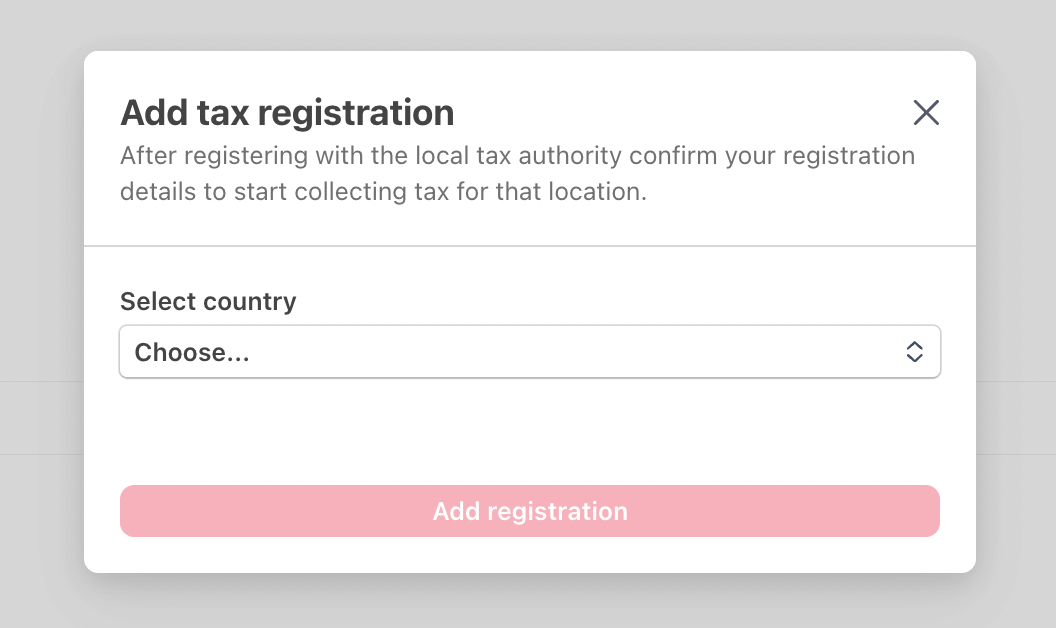
1. In **All registrations**, click **Add** (or **Add registration**).
2. In the pop-up:
1. Select your **country**
2. Select the **registration** that applies to you (for example, a province/state tax)
3. Click **Add registration** to save.
Once saved, you’ll see the registration in your list with its status and start date.
{% hint style="info" %}
Need to reconcile what was collected?
Use [Transactions & Payouts](/payments/transactions-and-payouts.md) to export payment data.
{% endhint %}
---
# Agent Instructions
This documentation is published with GitBook. GitBook is the documentation platform designed so that both humans and AI agents can read, navigate, and reason over technical content effectively. Learn more at gitbook.com.
## Querying This Documentation
If you need additional information that is not directly available in this page, you can query the documentation by asking a question.
Perform an HTTP GET request on the following URL with the `ask` and `goal` query parameters:
```
GET https://uni.fotello.co/payments/tax-collection.md?ask=&goal=
```
`ask` is the immediate question: it should be specific, self-contained, and written in natural language.
`goal` is what the user is ultimately trying to achieve, the reason they need the answer. Sharing it helps GitBook give you a better, more relevant answer. A goal is most helpful when it describes the outcome the user wants rather than restating the question. For example, with `ask=how do I create an API token`, a goal like `automate deployments from our CI pipeline` lets GitBook tailor the answer to that use case.
The response will contain a direct answer to the question and relevant excerpts and sources from the documentation.
Use this mechanism when the answer is not explicitly present in the current page, you need clarification or additional context, or you want to retrieve related documentation sections.